About Dacepton®

What is Dacepton®?
Dacepton® is the name for the medicinal product:
Apomorphine Hemihydrate Hydrochloride.1
The device and medicine work together to reduce your ‘OFF’ symptoms when
your oral medications are not controlling your motor fluctuations optimally.
Dacepton® is a medicine that can be administered through one of two devices:
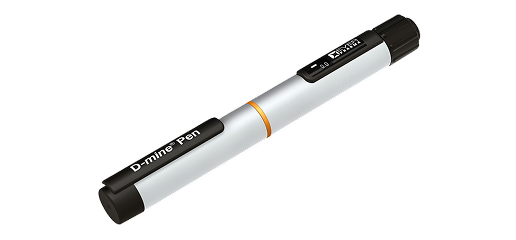
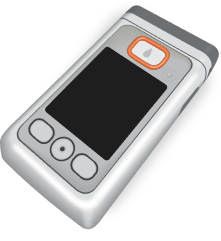
What is
Apomorphine?1
Apomorphine is a medicine that may help to reduce the amount of time spent in an ‘OFF’ state and reduce symptoms associated with being ‘OFF’ such as stiffness, slowness and pain when moving.
Apomorphine is not available as a tablet as it is broken down by your liver after absorption through your stomach and small intestine. Apomorphine is given as an injection through a needle into the tissues under your skin, and enters your bloodstream without needing to be absorbed from your gut and pass through your liver.
Results in 4-12 minutes

My gut and my
Parkinson’s disease
Over time, you might have noticed that you need to take more tablets to manage your Parkinson’s disease, and it is not as effective as it used to be. Parkinson’s can affect all types of muscles, including your stomach. This can cause your digestion to slow down.3,4,5

This is called Gastroparesis. That means your stomach can't absorb your tablets as quickly as it used to.
This may happen when:
Preparing for
Apomorphine

To see if Apomorphine works for you, you will need a response test.
The test helps find the right dose for you.
- Your doctor might ask you to lower or withhold your Parkinson's medication on the day of the test.
- The test can sometimes take up to 4 hours.
- You will be given several Apomorphine injections to check your movement while you are in an OFF state. This is to check how you respond to different doses of Apomorphine and monitor any side effects.

Before the Test
Three days before the test and as directed by your healthcare professional, you may be prescribed an anti-nausea medication.
It is important that you take this medication as prescribed. Apomorphine may make you feel sick when you are exposed to it for the first time.
The Test
In the response test, your healthcare professional or your D-mine® Care nurse advisor will do a series of small injections using the D-mine® device. These needles are short and fine and are injected into an area just beneath your skin. After each injection you will be asked to do a number of tasks including standing, walking or finger tapping.
If your response test shows that you have a positive response to Apomorphine your healthcare professional will give you a prescription and a device suitable for you.
Injecting
Dacepton can be self administered by injection or infusion.
Both methods deliver the drug through a short, fine needle into the fatty layer under the skin. This is called a subcutaneous injection.
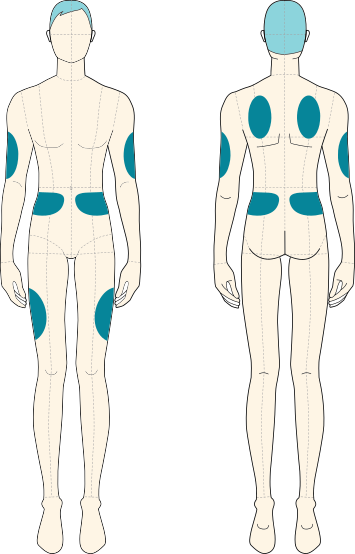
Recommended injection sites include:
- The lower part of the stomach (abdomen)
- The outside of your thigh
- The upper arm
- Lower back
Apomorphine should not be used via intravenous routes (injected into a vein).
Ask your healthcare professional if you need any support in this.

- Keep skin dry and wipe away any residual drops of Dacepton®.
- Massage your skin by hand or with a massage device (up to 10 minutes is optimal). This may help prevent the formation of skin nodules.
- Do not insert a needle into the same area 2 days in a row and try to alternate different areas to avoid irritation.
- Do not insert a needle into:
- Scar tissues
- Area of skin that is red or sore
- Area of the skin that is infected or damaged
- For Dacepton infusion:
- Always remove the infusion line gently.
- When inserting a new infusion line ensure this is always at least 2 inches (5cm) away from any recent infusion sites and 2 inches (5cm) away from your belly button.
What are the possible
side-effects of Apomorphine?
Like any other medication, Apomorphine has a list of known side-effects. Not everyone will get the same side effects but it is important you are aware of these so you will know what to expect.
Most commonly, Apomorphine can cause nausea and vomiting. This is why you will be prescribed an anti-nausea medication before your response test. The nausea doesn’t affect everyone and usually occurs in the initial stages of Apomorphine therapy.
Apomorphine is absorbed quickly from where it is injected but it can build up under the skin and sometimes cause skin reactions. This is why you should use a different spot each time you inject. Common side effects include low blood pressure (feeling dizzy or lightheaded), vivid dreams, seeing things that aren't there, feeling sleepy, and feeling confused.
Please refer to the Patient Information Leaflet for additional information. This can be found at:
Who are the D-mine®
Care Nurse Advisors?

EVER Pharma has a team of highly qualified and experienced D-mine® Care Nurse advisors managed by Bionical Health. They can help with education and support related to Dacepton and D-mine® devices.
These nurses work alongside your NHS Parkinson’s Nurse and physician to answer any questions and concerns related to your Dacepton® therapy. Please see the contact page for the D-mine® Care Nurse advisor support telephone lines.
- EMC (2023) SPC for Dacepton (apomorphine hemihydrate hydrochloride) solution for infusion 10mg/ml . Electronic Medicines Compendium. Datapharm Communications Ltd. Link. [Last accessed November 2025.]
- LeWitt PA (2004) Subcutaneously administered apomorphine: pharmacokinetics and metabolism, Neurology, 62 23;62(6 Suppl 4):S8-11.
- Soliman H, Coffin B, Gourcerol G (2021) Gastroparesis in Parkinson Disease: Pathophysiology, and Clinical Management, Brain Sci, 11(7):831.
- Goetze O, Nikodem AB, Wiezcorek J, Banasch M, Przuntek H, Mueller T, Schmidt WE, Woitalla D (2006) Predictors of gastric emptying in Parkinson’s disease, Neurogastroenterol Motil, 18(5):365-75.
- Heetun, Z, Quigley E. M (2012) Gastroparesis and Parkinson’s disease: A systematic review. Parkinsonism & Related Disorders, 18(5), 433.